Structure was my favourite escape (why I built a voice journal)
I kept escaping chaos by adding structure, and it cost me my internal compass. Why journaling kept dying on me, why ChatGPT kept agreeing with me, and the voice journaling app I built instead.
I have a full life, and I mean that literally.
I like to party. I like to travel. Every few months I go back to my hometown to be with family. At work, I’m the dependable one, the person things can be handed to. With friends, same. I show up. Recently I even started taking the gym seriously, sleeping early, eating better. Not every day though, the older messier version of me still surfaces, but it’s real.
From the outside, that’s a life that’s working. And still, some nights, I’d lie awake at 3 a.m., completely unable to answer the simplest question there is: “What’s actually wrong?”
Not “What’s pending?” or “What’s next?”. Those I could answer in my sleep. I mean a kind of fog; irritable for no reason, tired in a way that sleep didn’t fix, carrying something I couldn’t point my finger at.
The pattern I couldn’t see
It took me years to notice what I was actually doing, and it’s this:
Whenever life got too chaotic, I didn’t sit with it. I added structure.
A rough patch? New routine. Things feeling out of control? New tracker, new plan or a new commitment. And here’s the trap, it works! Structure smooths the chaos just enough to glide over it. The week fills up, boxes ticked, the momentum feels like progress. Gliding looks exactly like coping and it’s even rewarded like growth.
But the things that actually mattered, the conversation I was avoiding, the feeling I didn’t want to name, the question of whether I even wanted what I was sprinting toward, remained unanswered. They kept getting rescheduled indefinitely, by a person who was VERY good at scheduling.
It cost me more than I realised. Slowly, the locus of my life moved outside of me. My days were run by calendar slots, deadlines, other people’s ability to depend on me, the next trip, the next milestone. All external points. No internal compass. And when every direction in your life comes from outside, you slowly lose the ability to generate one from inside.
That’s why “What’s actually wrong?” had no answer. I had never sat long enough with myself to know.
So I tried journaling
Here’s what surprised me: IT WORKED!!
When I actually did it, the act of externalising, getting the jumble out of my head and onto a page where I could look at it, unjumbled things. Patterns I couldn’t see from the inside were obvious in ink. For the first time, some of those postponed questions actually got sat with. For a few weeks I had glimpses of exactly the thing I’d been missing.
Then the habit died, the way it does for everyone. And the failure was never the value, it was the input cost. The pen goes missing. The diary in the other room. And at 11 p.m., after a day that had work and gym and dinner and calls in it, the will to sit down and compose coherent sentences about my inner life is simply not there. Journaling asks for structured output from a brain that has nothing left to structure with. A habit that expensive, at exactly the moment you’re poorest, is a dead habit walking.
If you’ve filled three pages of every notebook you’ve ever owned, you already know this feeling. I wrote more about that specific failure in how to journal when you hate writing.
So I tried ChatGPT
The obvious next move: talk it through with the machine.
And it was useful, sort of. Until I noticed what was actually happening. It agreed with me. Not always in words, but in shape. It took my framing and polished it. When I came in resentful, it helped me build a better case for my resentment. Worse, I caught myself steering: phrasing things so I’d get the response I already wanted to hear. The tool was biased towards pleasing me, and I was biased towards getting pleased.
A journal that talks back with opinions isn’t a journal. It’s a debate partner you can rig. I needed a mirror. What I had was a very articulate yes-man.
The wrong end of the pipeline
Then the realisation the whole story had been circling finally landed: journaling was failing me for the same reason everything else had, structure in the wrong place.
Journaling demands structure at the input: sit down, be coherent, write well, at night, exhausted. That’s the part that kills it. So flip the pipeline. Accept the messiest input imaginable, me, tired, rambling half-sentences at my phone without any polish, pure rawness. And apply the structure to the output instead: What was I feeling? Who kept coming up? Which topics circle back, week after week? Let that structure be extracted instead.
The input cost collapses to one minute of talking, and talking is the one thing I can still do at 11 p.m.
So I built it. I know! I see the irony!
I’m an Android developer. My answer to a life problem was, again, to build a system. I know exactly how that looks, chaos got loud and the structure guy did the structure thing.
But there’s a difference. Every structure I’d ever built was to glide past my own life. This is the first one whose only job is to make me sit with it. It doesn’t organise my days, it doesn’t optimise anything. It takes the one minute of rambling I can manage and hands me back the picture I was too tired, or too busy gliding, to draw.
It’s called Dearly.
You open it, tap the ink drop, and talk. Ramble. Trail off. Contradict yourself. A minute later your voice has become a cleanly inked journal page. It reads like you journaled properly, but you didn’t!
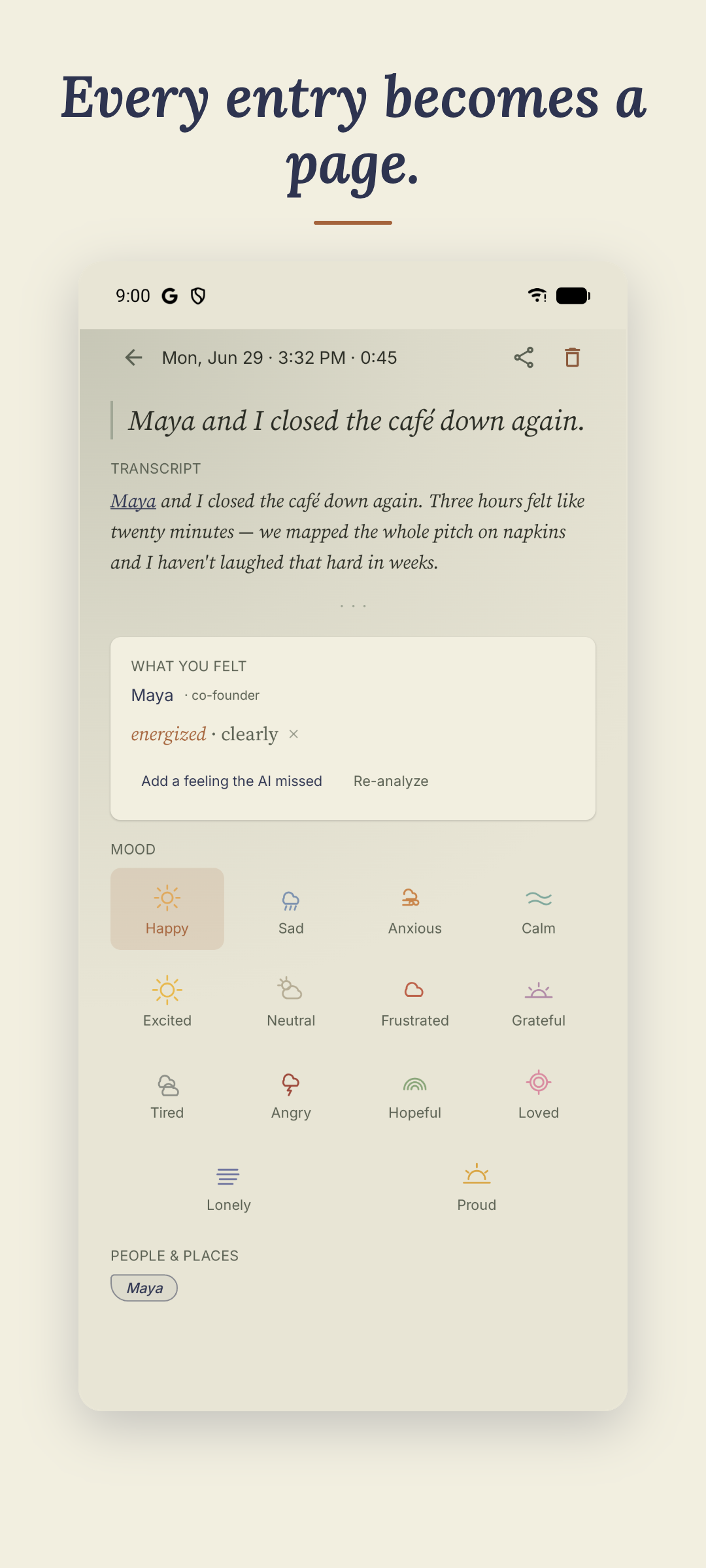
Underneath, carefully prompted AI does the structuring I could never do at night. It reads the feelings under the words, notices the people who keep appearing (your month has a cast, apparently!), and surfaces patterns like “When work comes up, worry tends to follow”. And when you want to go deeper, it offers one gentle reflection question drawn from your own words. Never an opinion! That’s the design answer to the yes-man problem: a mirror that helps you look and refuses to tell you what to see.
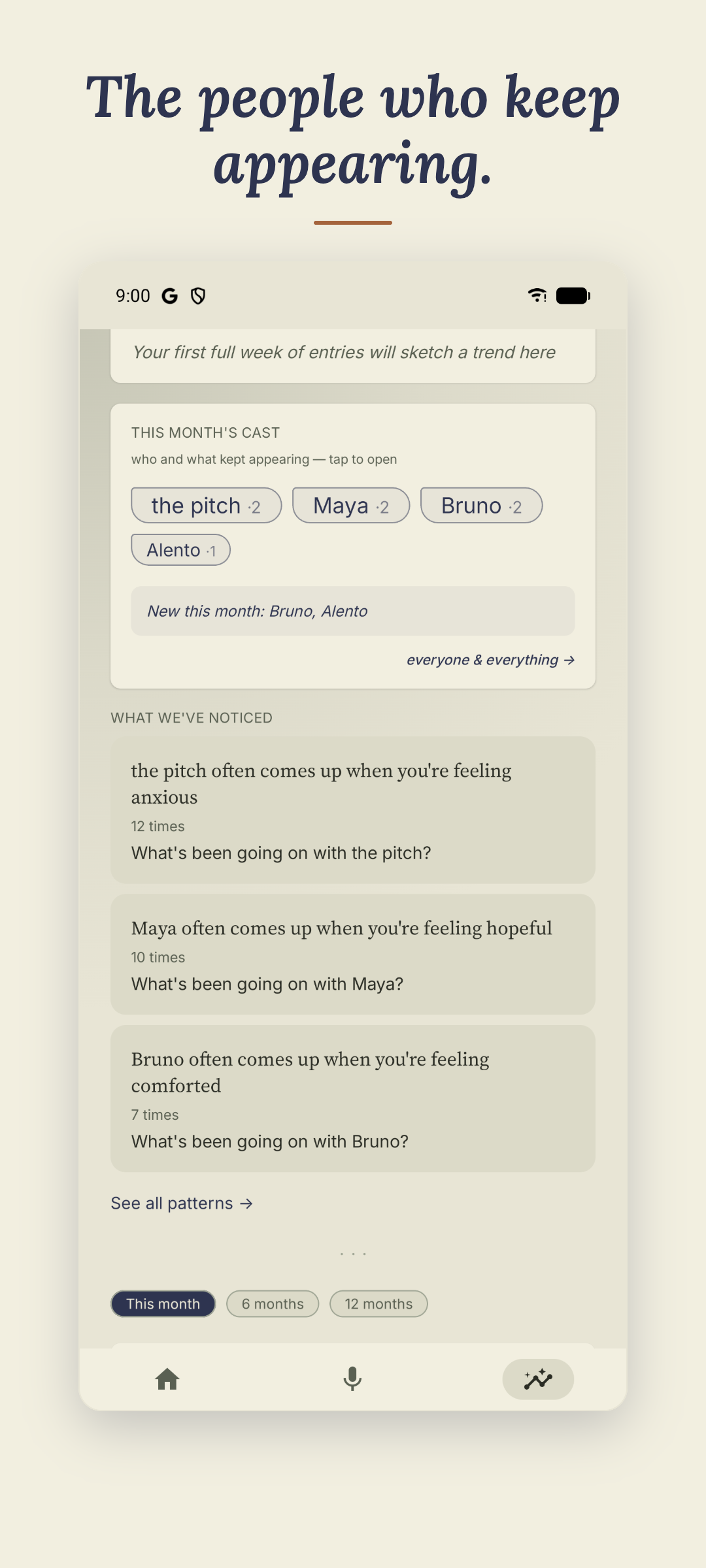
Slowly, entry by entry, the compass moves back inside. Not because the app tells you who you are, but because it keeps showing you what you actually said, felt and circled back to, until you can see the shape of it yourself.
What it is, and what it isn’t
It’s not therapy, and it doesn’t pretend to be either. It’s a journal. The lowest friction one I could build, with enough intelligence to hand you back what you put in.
And because a diary is the most private thing a person owns: your voice recordings stay on your device. Audio travels over an encrypted connection only to be transcribed, never stored. The journal opens to your fingerprint. You can delete your account and every trace of your data from within the app. Building this taught me that trust isn’t a feature of the app, it’s the product itself. The full picture of what leaves your phone is in the private voice journal guide; what it became is on the Dearly AI voice journal page.
If any of this sounded like your 3 a.m.
Dearly is on Android, free to start. Recording and 10 transcriptions a day are free forever, and the AI insights come with a 15 day free trial, no card needed.
Start tonight. Say the thing you’d never slow down to write.