How to journal when you hate writing (speak instead)
You don't hate journaling — you hate writing. How a voice to text journal lets you talk for one minute a day, even if every notebook goes empty by page three.
Every journal you’ve owned is empty after page three
You bought the nice notebook. Maybe more than once. You downloaded the app that everybody recommended. You made it to page three, or day four, or the end of week one — and then it quietly stopped.
That’s not a discipline problem. That’s a format problem.
The blank page has a specific kind of pressure that sneaks up on you. A journal isn’t just notes — it feels like something that should be written well. So before you’ve even started, you’re already judging the quality of what you’re about to produce. The paralysis sets in. You close the notebook. You tell yourself you’ll do it tomorrow when you have something worth saying.
And then there’s the time. Something meaningful happened today — a hard conversation, a small win, a feeling you can’t quite name. Living it took ninety seconds. Writing about it takes fifteen minutes of staring at a screen.
Those two things — the pressure to perform and the effort-to-output ratio — kill more journaling habits than anything else. The medium is wrong for the job.
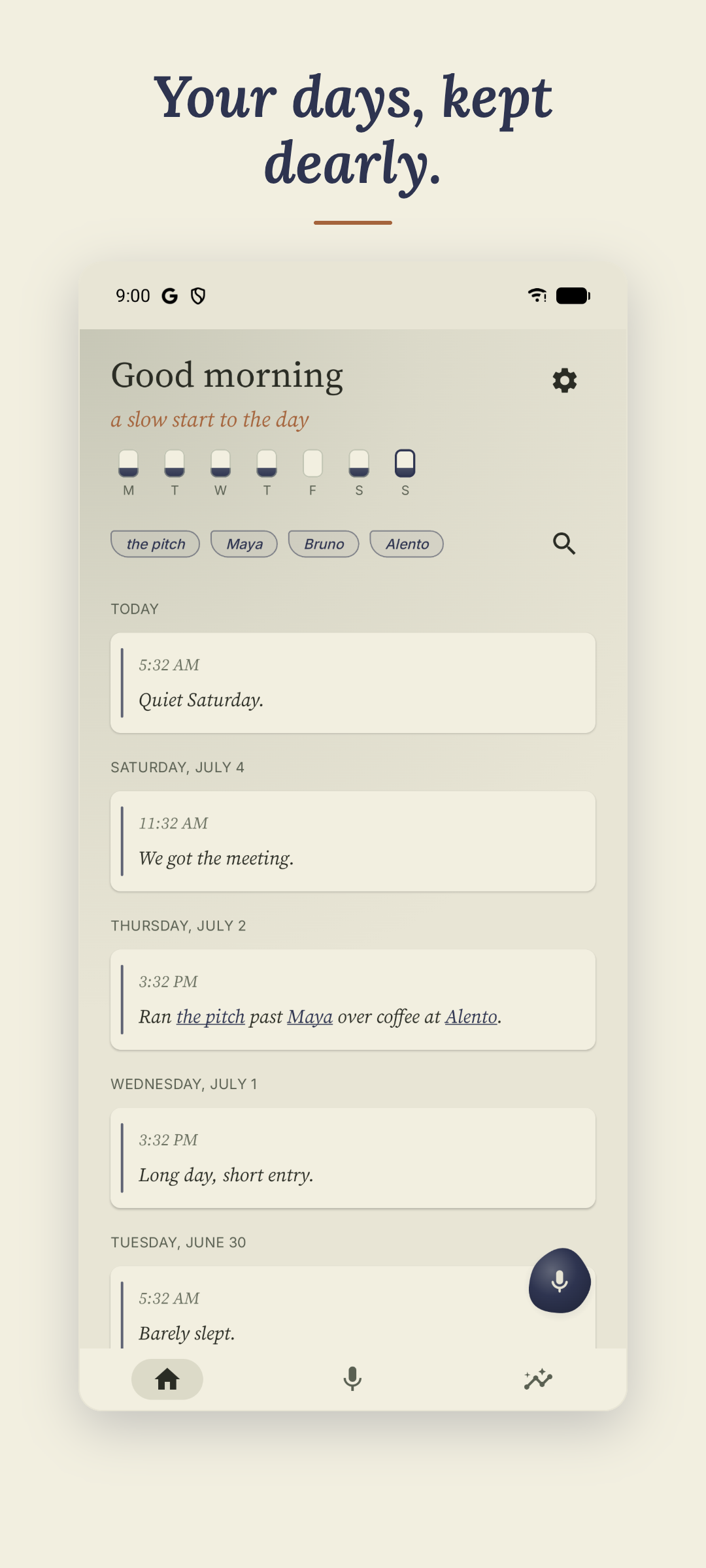
You don’t hate journaling. You hate writing.
Those are different things, and the distinction matters.
Journaling is reflection. It’s the act of pulling something from your day and holding it up to look at it. The writing is just one delivery mechanism — one that comes with a lot of friction most people would rather skip.
Here’s the thing that changes everything: you already know how to reflect out loud. You do it every time someone asks how your day was and you actually answer honestly. You do it on the phone with someone you trust. You do it in your own head on the commute home, cycling through what happened.
That’s journaling. It just isn’t written.
Journaling is the reflection, not the handwriting. If you can talk about your day, you can journal.
Speaking removes the performance entirely. Nobody talks in polished prose — there’s no expectation of clean sentences or literary insight when you’re just talking. The internal editor that kills your written entries doesn’t activate when you open your mouth. You say the thing, stumble through it, correct yourself mid-sentence, and that’s fine. That’s actually the point.
Here’s what that sounds like in practice — a real entry, stumbles and all, going in unedited:
The one-minute rule
Commit to sixty seconds. Not as a goal — as a ceiling.
One minute is too small to skip. On your worst day, when you’re exhausted and have nothing to say and the last thing you want is another item on the list, sixty seconds is still achievable. You can always find sixty seconds.
The natural impulse is to do more once you’ve started. Resist it at first. One minute forces you to say what actually matters, because you can’t say everything. There’s a useful constraint in that — you’ll notice which thought rises to the top when you only have time for one.
A month of one-minute entries beats three perfect pages and then three weeks of silence. Consistency is the only thing that makes a journal useful. You can’t look back on patterns you didn’t capture, and you can’t capture anything on the days you convinced yourself there wasn’t enough time.
Start with sixty seconds. The length will find itself once the habit is real.
Attach it to something you already do
New habits fail when they need a new slot in your day. You’re already context-switching constantly — adding another thing that requires remembering, finding time, and making a choice is exactly where habits leak out.
The fix is anchoring. Attach the sixty seconds to something you already do automatically.
Three examples that actually work:
- With your morning coffee. The cup is brewing, you’re standing in the kitchen, you have ninety seconds. Record before you check your phone. You’re capturing the emotional state before the day’s noise comes in.
- On the walk home. If you walk any distance at the end of the day, that time is already yours. Talking while walking is natural — you’ve probably done it on a phone call. The movement helps; something about walking loosens what you’re trying to say.
- Lights-out in bed. Low effort, no setup, the day is still fresh. The downside: you might fall asleep mid-entry, and evening entries skew toward what went wrong rather than what went right. Morning entries tend to be more forward-looking. Neither is better — pick the anchor that’s actually reliable for you.
The anchor matters more than the time of day. Pick the one that has no decision required.
Make it rereadable, or you’ll quit anyway
Here’s the failure mode nobody warns you about: you make it two weeks of consistent voice entries, and then you stop anyway — not because the habit broke, but because the journal feels pointless.
Raw audio does this. You record, you accumulate audio files, and you never go back to them. Relistening to yourself is uncomfortable in a way reading isn’t. The emotional replay of your own voice, especially when you’re processing something hard, is genuinely difficult. And searching or skimming a folder of audio is basically impossible. So the entries sit there, and the reflection part — the whole reason you started — never actually happens.
Transcription fixes this completely. When a sixty-second voice entry becomes a paragraph of text, it works like any other journal entry. You can skim it in ten seconds, search it weeks later, read back a month in five minutes.
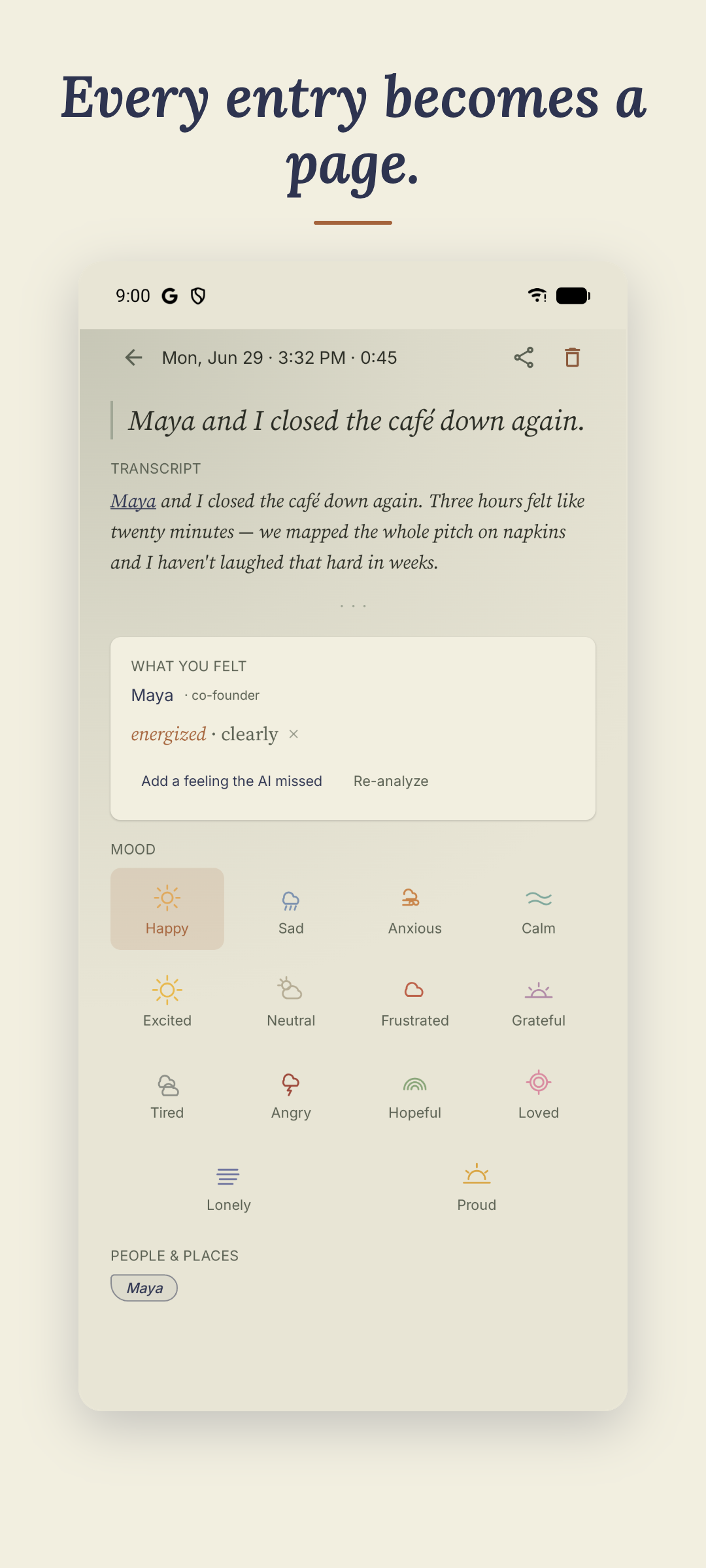
This is what Dearly — voice journal app for Android by BroooApps is built for. The ink-drop record flow gets you in and out in under a minute — press, talk, done. The free plan includes unlimited recording and 10 transcriptions a day, which is more than enough for daily journaling. Your recordings live on your device; audio travels over an encrypted connection only to be transcribed, then it’s discarded — only the transcription text syncs.
Once your entries are text, you actually return to them. That’s when the journal becomes useful — not during recording, but in the rereading. If you want more on building the habit around voice entries, the voice journaling guide covers the full practice in depth — and if you want the transcribing done for you, Dearly is a voice journal that writes the page and reads it back.
Five prompts for people who hate journaling
When you press record and your mind goes blank, start with one of these:
- Complain about something, out loud, for one minute — that counts.
- Say the one thing you’d never write down.
- Tell me what you’re avoiding and why you haven’t dealt with it yet.
- Describe one moment from today, any moment, in as much detail as you can.
- What do you wish had gone differently — and what would you do next time?
None of these require you to be in a particular mood or have had a significant day. They work when nothing happened. They work when too much happened and you don’t know where to start. They work on the days when the only honest answer is “I don’t know” — because that’s something worth capturing too.
Dearly is a voice journal for Android by BroooApps. Free plan: unlimited recording, 10 transcriptions per day.