Voice journaling: a complete guide (2026)
What voice journaling is, why speaking sustains a habit better than writing, and how to pick a voice journaling app — prompts and rituals included.
What is voice journaling?
Voice journaling is keeping a diary by speaking instead of writing — you record a short spoken entry, and (with modern apps) it’s transcribed into text you can reread and search.
That’s it. No special technique, no fixed length, no rules about when or how often. You press record, say something true about your day, and stop. The format is as old as spoken word; what’s changed is that your phone can now turn a 90-second voice note into searchable, rereadable text in seconds.
People come to it for different reasons — wanting to journal but never sustaining a writing habit, needing to capture thoughts while commuting, or just finding that speaking feels more honest than typing. Whatever the entry point, the core practice is the same: speaking as a tool for reflection, not just communication.
Why speaking beats typing for most people
Speed
People speak at roughly 130–150 words per minute. On a phone keyboard, the typical typing speed is closer to 40 words per minute — and that’s if you’re practiced at it. A one-minute voice entry produces roughly the same amount of content as a ten-minute typed one. That math matters when you’re trying to build a habit around an already busy day.
It also changes what gets captured. In a typed entry, you’ll often cut the middle-complexity thoughts — too long to type quickly, not urgent enough to earn the time. In a voice entry, those thoughts make it in because the friction of saying them is zero.
Lower friction
One of the most common reasons writing journals fail is the blank page. You sit down, open the app or notebook, and nothing comes. Then you close it, and the habit breaks.
Voice journaling sidesteps this almost entirely. You already know how to talk about your day — you do it every time someone asks “how was it?” The entry doesn’t need to be polished or organized. It just needs to start. Starting is easier when you’re talking.
Emotional honesty
Written language is self-edited by default. When you type, there’s a small but real gap between feeling and output — long enough for the internal editor to smooth things over, make them sound better, or leave the uncomfortable parts out.
Spoken language is less filtered. You say things in a voice entry you’d cross out if you were writing them, because it’s too late — you’ve already said them. That rawness is the point. The stumbles and backtracks in a voice entry carry emotional information that polished prose doesn’t.
Accessibility
Voice journaling works in places writing doesn’t. On a morning walk. In bed with the lights off. During a commute. In the five-minute gap before a meeting when you have something on your mind.
It also opens the door for people for whom writing is physically hard — motor difficulties, vision issues, pain conditions — to keep a journal at all. The habit shouldn’t require sitting at a desk.
How to start a voice journal in 5 steps
-
Anchor it to an existing ritual. The habit is much more likely to stick if it’s attached to something you already do — morning coffee, brushing your teeth at night, getting into bed. You’re not adding a new slot to your day; you’re extending one that already exists. Pick one and commit to it for two weeks before evaluating.
-
Cap it at one minute. Not as a target — as a ceiling. At least to start. One minute forces focus: you can’t meander through everything, so you say what actually matters. It also removes the pressure to produce something worthwhile. Sixty seconds is always achievable, even on a bad day, and consistency beats depth in the first month.
-
Open with the same question every time. A fixed opening question short-circuits the blank-page problem. “What’s on my mind right now?” is enough. When you already know the first sentence, the rest tends to follow. You can vary the prompts once the habit is solid, but the first two weeks go better with a consistent opener.
-
Never re-record. The stumbles, the restarts mid-thought, the moments where you say “actually, no, what I mean is” — those are the diary. They show how you actually think, not how you’d like to have thought. Re-recording is just the internal editor at work. Resist it. Move on.
-
Reread weekly, not daily. Patterns don’t show up in individual entries; they show up at week scale. The things you keep coming back to, the same anxieties showing up in different clothes, the small wins you logged and then forgot — those are only visible when you look at a week together. Set a reminder for Sunday evening, spend ten minutes reading the week’s transcripts, and notice what repeats.
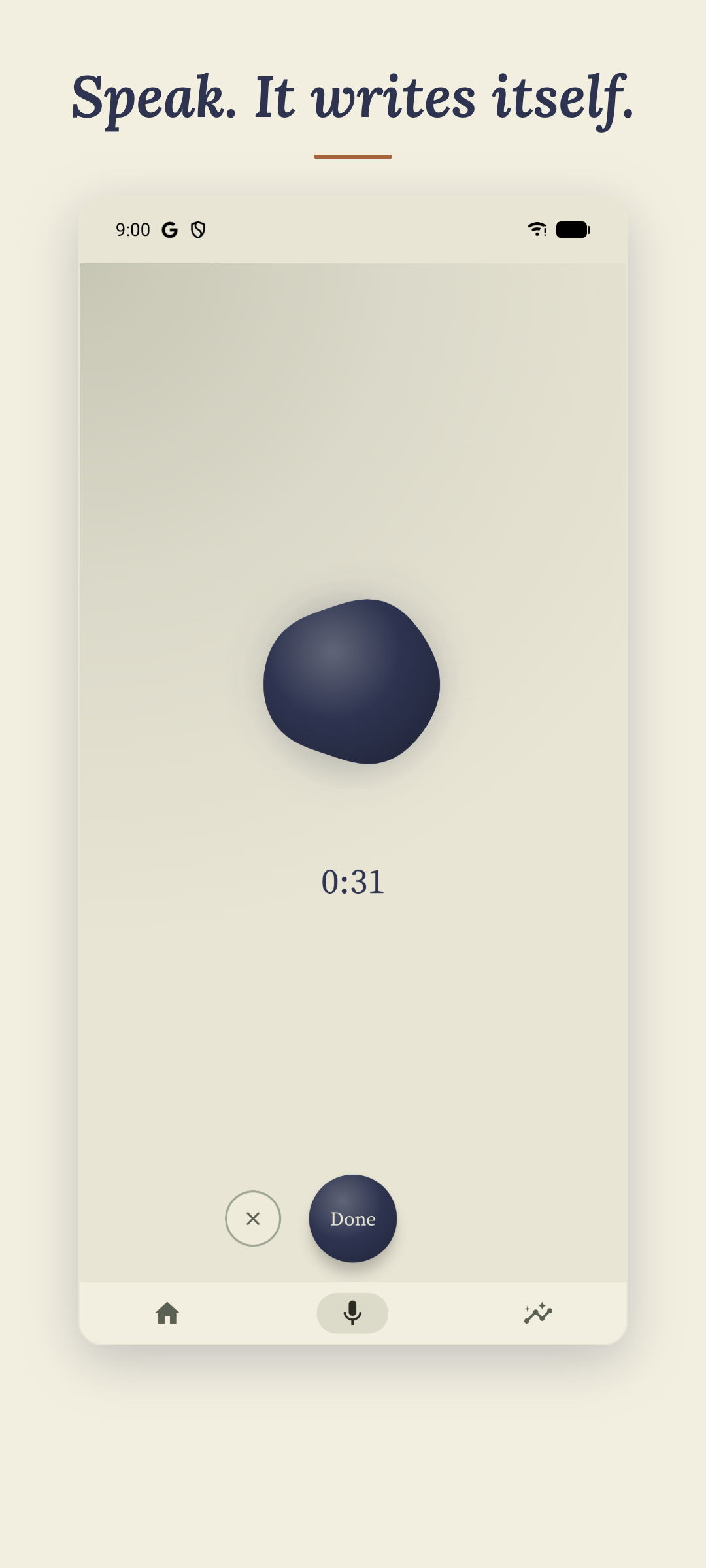
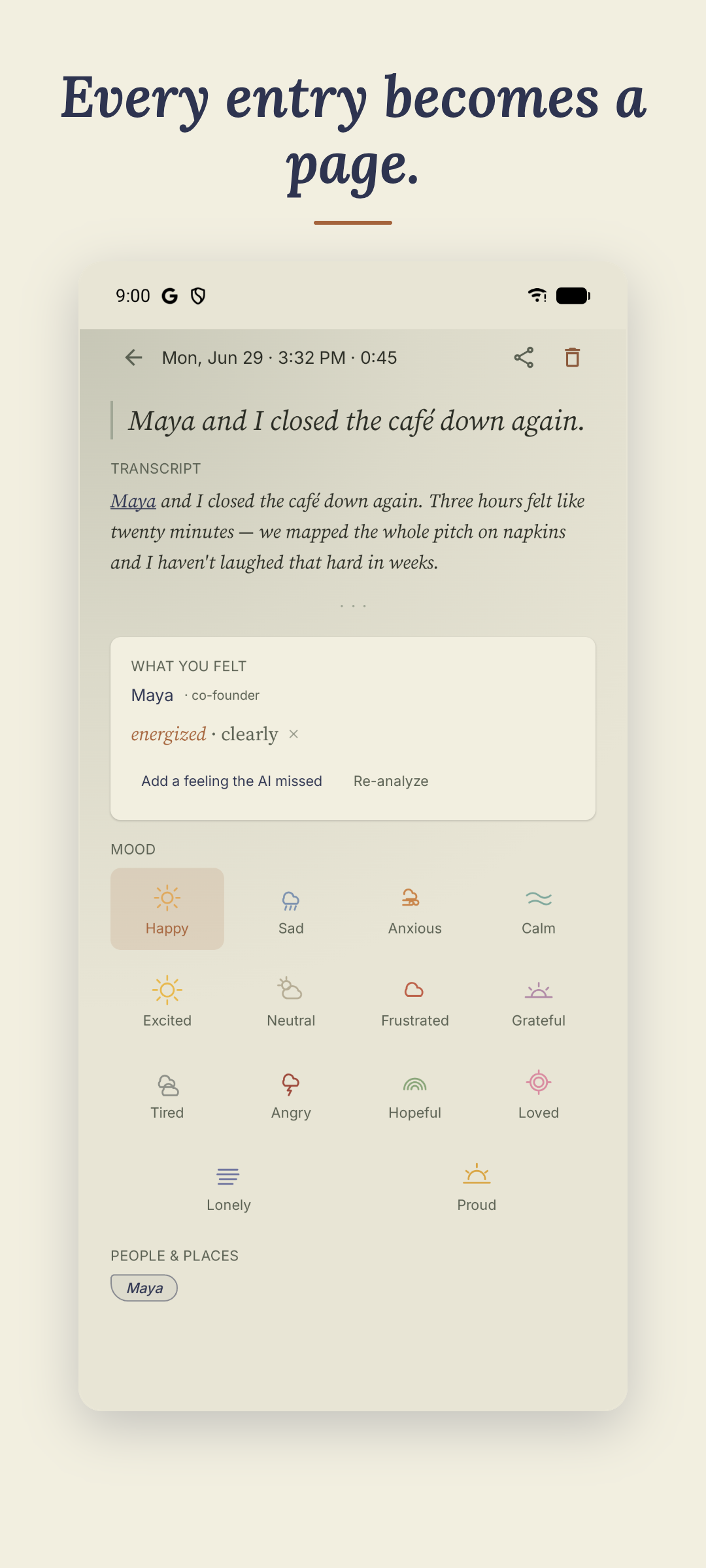
Here’s the whole loop: press the orb, talk, and the entry is already written by the time you stop:
10 prompts when you don’t know what to say
- What’s on my mind right now, and why won’t it leave?
- What drained me today, and what refilled me?
- What would I tell a friend who had my exact day?
- What am I avoiding, and do I know why?
- Who did I think about today and why — what was that about?
- What’s something I did today that I’d do differently?
- What am I looking forward to, even slightly?
- What’s the thing I haven’t said out loud to anyone yet?
- What surprised me — in any direction, good, bad, or just unexpected?
- If today was a chapter title in a book about my life right now, what would it be called?
None of these require you to be in a particular mood or have had a significant day. They work on ordinary days, which is most days, and that’s where habits are built or broken.
Voice journaling vs written journaling
| Voice | Written | |
|---|---|---|
| Effort per entry | Low — speaking is faster and requires no setup | Higher — typing on a phone is slow; a notebook requires finding it |
| Emotional honesty | High — less self-editing in real-time speech | Moderate — the act of writing invites revision |
| Rereadability | Low without transcription; high with a transcribing app | High — text is inherently rereadable |
| Searchability | Not searchable as audio; fully searchable with transcription | Fully searchable in a digital notes app; not at all in a paper journal |
| Privacy surface | Audio files are large and biometric; depends heavily on the app | Text is sensitive but doesn’t contain a voiceprint |
| Habit stickiness | Higher for most people — less friction means fewer skipped days | Lower on average — blank page and typing friction cause drop-off |
The honest summary: if you’re choosing between a transcribing voice app and a digital notes app, they’re close. Written wins on rereadability if there’s no transcription. Voice wins on everything else for most people — and the habit data on journaling consistently shows that the format you actually keep doing is the one that works.
What to use: recorder, notes app, or a dedicated voice journal
A plain voice recorder
Every Android phone ships with a voice recorder. It’s zero-setup, it’s offline, and it works. The downside is everything that comes after recording: the audio is unsearchable, the files accumulate with no organization, and — honestly — most people never relisten. A folder of audio files isn’t a journal; it’s an archive you won’t use. Voice memos work for occasional capture but they don’t build the reflective habit.
Typing into a notes app
The rereadability problem is solved, and you probably already have the app. What comes back is the same friction that pushed you to voice journaling in the first place: the blank page, the slow phone keyboard, the sense that you need to produce something coherent before you can stop typing. For people who already have a writing habit, a notes app is fine. For people trying to build one, the friction is usually what breaks it.
A dedicated voice journal app
This is where the two formats converge. You record like a voice memo; you get back a text transcript you can reread, scroll through, and search. The app handles organization, date indexing, and ideally some kind of privacy layer so your most sensitive thoughts aren’t sitting exposed.
Dearly — voice journal app for Android by BroooApps is built for exactly this. The free plan gives you unlimited recording and 10 transcriptions a day — which covers daily journaling comfortably. Your recordings live on your device; audio travels over an encrypted connection only to be transcribed, then it’s discarded — only the transcription text syncs, and a biometric lock keeps the app closed to anyone who picks up your phone.
If you want more detail on how it handles audio privacy specifically — including what happens at transcription, how deletion works, and what analytics it uses — the privacy guide covers all of it, and the Dearly AI voice journal page has the current feature and platform list.
Common questions
How long should a voice journal entry be?
Sixty to ninety seconds is the sweet spot, especially when starting out. That’s long enough to actually reflect on something, short enough that you never feel like you don’t have time. As the habit settles, some entries will naturally run longer — maybe three to five minutes when something significant happened. Let it expand naturally, but don’t set a floor. A thirty-second entry on a quiet day is better than no entry.
Is voice journaling as effective as writing?
The research on journaling points to reflection and consistency as the active ingredients, not the medium. The format matters less than whether you keep doing it. Voice wins if it’s the format you actually sustain — and for most people, it is, because the friction is lower. If you’ve tried written journaling twice and abandoned it both times, that’s a signal worth paying attention to.
Do I have to relisten to my recordings?
No — and most people don’t. Relistening feels like homework, and the emotional replay of your own voice can be uncomfortable enough to deter the habit. What makes voice journals rereadable — and worth keeping — is transcription. Once your entry is text, you read it the way you’d read anything else. The audio becomes a backup, not the primary artifact. If you’re using a voice recorder with no transcription, you’ll likely stop relistening within a few weeks. If you’re using an app that transcribes, you’ll find yourself actually returning to past entries because reading them back is frictionless.